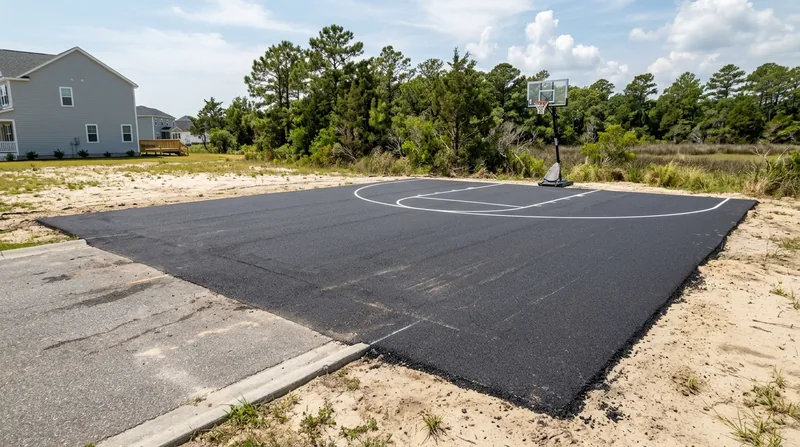




A sports court or path paving project in Wilmington sits on some of the most challenging ground in the coastal Carolinas. The peninsula's sandy soil and high water table, especially in the newer subdivisions spreading into Pender and Brunswick counties, mean that a basketball court, tennis court, or walking path built without proper base preparation and drainage will settle, crack, and wash out within a season or two, particularly after the heavy rains that follow hurricane season. We grade and compact a stable base through the soft subgrade, install drainage that sheds water away from the court surface, and finish with hot mix asphalt that stays flat and playable year after year. Since 2014, we've built courts and paths across Wilmington, Wrightsville Beach, Carolina Beach, and the surrounding areas, working within the real constraints of this coastal terrain.
Why Proper Base and Drainage Matter for Courts and Paths in Wilmington
Wilmington's location on a peninsula with tidal creeks and marsh backing up to many residential lots means the water table sits close to the surface in much of New Hanover and Pender counties. A backyard court or path poured directly on sand or on a thin, unstable base will absorb water from below, soften, and fail long before the asphalt surface itself wears out. The failure is not heave from frost (Wilmington's winters are shallow and mild), but saturation, settlement, and edge erosion where sandy fill was never properly confined and compacted. Getting the base right is the single most important investment in a court or path that will last.
- We excavate and grade the subgrade to remove soft material and establish positive drainage away from the court surface.
- We install a compacted base layer of crushed stone or recycled asphalt that provides a stable platform and allows water to percolate through rather than pool underneath.
- We proof-roll the base to verify compaction and bearing capacity before any asphalt is laid.
- We finish with hot mix asphalt graded and sloped to shed water fast, keeping the court flat and playable through hurricane-season downpours.
Proper base preparation prevents the soft, saturated subgrade failures that dominate court and path repairs in this area.
Local example: A residential court in Porters Neck built on native sand without base preparation settled 2 to 3 inches within 18 months. A rebuild with proper grading, compacted base, and drainage stayed flat and playable for years. The difference was not the asphalt itself, but what was under it.
For more on how we prepare ground for paving projects, see our gravel driveway installation and grading page, which covers the same base principles that apply to courts and paths.
How We Build a Court or Path: The Process in Wilmington
Every court or path job starts with a site visit and measurement. We assess the existing ground, the water table, and drainage patterns, then propose a base and surface design that will work in Wilmington's coastal environment. We do not cut corners on the base, because the base is where 80 percent of the cost and 100 percent of the durability live. The steps are straightforward and deliberate.
- We call North Carolina 811 for a free utility locate before any excavation begins, as required by state law.
- We excavate to remove soft subgrade material and establish the proper grade and slope for drainage.
- We haul in and compact a stable base layer, typically 4 to 6 inches of crushed stone or recycled asphalt, depending on the soil and the intended use of the court or path.
- We proof-roll the base with heavy equipment to verify compaction and detect any soft spots that need rework.
- We lay hot mix asphalt in lifts, finishing to the specified thickness (typically 2 to 3 inches for a court or path) with proper slope and edge containment.
- We allow the asphalt to cure for 24 to 48 hours before the court or path is put into play.
The result is a court or path that sheds water, stays flat, and holds up to regular use and Wilmington's wet season.
Real project example: A basketball court in Leland required full excavation to 18 inches to reach firm sand, then a 6-inch compacted base and 2.5-inch asphalt finish. The job took four days from excavation to cure, and the court has remained flat and playable through multiple hurricane seasons. The homeowner's initial concern about cost dissolved when they saw how much better the court played compared to the soft, settling surface it replaced.
For a detailed look at how we approach asphalt installation on other projects, visit our asphalt driveway paving page, which covers many of the same base and finishing principles.
Court and Path Paving Methods: Approaches and Costs
| Approach | Description | Best for |
|---|---|---|
| Full-depth court build on sandy subgrade | Excavate soft material, install 4 to 6 inches of compacted crushed stone or recycled asphalt base, finish with 2 to 3 inches of hot mix asphalt, sloped for drainage. | New courts or paths on native sand or where the existing surface has failed or does not exist. |
| Base preparation and overlay on existing court | Mill or remove the old asphalt, repair the base if needed, add new compacted base material where soft spots are found, then overlay with 1.5 to 2 inches of new hot mix. | Courts with a failing surface but a salvageable base, or where excavation is limited by utilities or access. |
| Recycled asphalt base with hot mix top | Use recycled asphalt millings (RAP) as the compacted base layer, then finish with virgin hot mix asphalt. RAP compacts well and provides good drainage. | Budget-conscious projects where a durable base is the priority and the court or path will see moderate use. |
| Tar and chip court surface | A lighter, less expensive surface of tar and stone chips, applied over a compacted base. Softer underfoot than hot mix, lower cost, but higher maintenance and shorter lifespan. | Low-traffic walking paths, recreational courts where play is casual, or temporary courts while a full build is planned. |
Sports Court and Path Paving Cost in Wilmington: What to Expect
A full-depth court or path paving project in Wilmington starts at around $8,500 for a small court or a modest path, and the cost rises with the size of the surface, the depth of excavation required, and the complexity of the base preparation. A standard 2,500-square-foot residential basketball or tennis court typically runs $12,000 to $18,000, depending on how much soft subgrade needs to be removed and replaced. A longer or more complex path, or a court in an area with a very high water table, can cost more. The single largest variable is the base: if the existing ground is firm and well-drained, the cost is lower; if we need to excavate deep to reach stable material, the cost goes up.
We provide a written estimate with tonnage specifications and a clear breakdown of what the base will be, what thickness of asphalt we are laying, and how the court or path will be graded for drainage. We do not quote per-square-foot, because paving is not a one-size-fits-all product. Two courts that look the same on the surface can require vastly different base work depending on the soil and water table. The only way to price a court or path honestly is to measure it, assess the ground, and give you a number backed by real specs.
For a complete look at pricing across all of our services, visit our pricing page. To get a free estimate for your specific court or path, call us at (910) 338-1662 or visit our contact page.
Sports Court and Path Paving Near Me: What Wilmington Homeowners Should Know When Hiring a Contractor
A court or path is a long-term investment in your property, and choosing the right contractor matters. Paving in North Carolina is not regulated by a single state license for all contractors, but any single undertaking of $40,000 or more does require a North Carolina General Contractor license from the NCLBGC. Below that threshold, no state license is required, though local building departments may have their own permitting and inspection rules. For most residential courts and paths in Wilmington, permitting is straightforward, but you should always verify with your local building department and your HOA (if you have one) before you start. We help homeowners navigate local permitting, but the final responsibility is yours.
When you call or meet with any contractor, including us, here is what to look for:
- Ask to see proof of liability insurance, and verify it covers asphalt paving work at your address.
- Request a written estimate that includes the dimensions of the court or path, the thickness and type of base material, the thickness of asphalt, and the total cost with no surprises.
- Ask how the contractor will handle drainage and what steps they will take to ensure the court or path does not settle or wash out.
- Get at least two estimates so you can compare scope, materials, and price; a single quote is never enough.
- Check references from recent court or path projects in Wilmington, Leland, or Carolina Beach, and call them.
- Verify that the contractor will call North Carolina 811 for a utility locate before any digging begins; this is the law.
- If your property is in an HOA, confirm that the contractor understands any architectural standards or material restrictions that apply.
A contractor who shows up at your door unsolicited with a price that sounds too good, no written contract, and a request for a large cash deposit is not someone to hire. Honest contractors work from detailed estimates, carry insurance, and stand behind their work with references you can actually call. For more information on choosing a paving contractor, call us at (910) 338-1662 or visit our contact page to request a free, no-obligation estimate for your court or path.
Sports Court & Path Paving in Wilmington: Pricing Guide
| Service | Price | Details |
|---|---|---|
| Small path or court (up to 1,000 sq ft) | Starting at $8,500 | Includes excavation, compacted base, and 2 to 2.5 inches of asphalt with proper slope for drainage |
| Standard residential court (1,500 to 2,500 sq ft) | Starting at $12,000 | Full-depth build with 4 to 6 inches compacted base and 2.5-inch hot mix finish; cost rises with excavation depth |
| Large court or complex path (2,500+ sq ft or difficult terrain) | On estimate | Site assessment required to determine base depth, drainage needs, and total excavation; water table and soil conditions drive final cost |
| Overlay or resurfacing of existing court | Starting at $6,000 | Milling or removal of old surface, base repair if needed, and 1.5 to 2 inches of new asphalt; depends on existing condition |
| Travel and estimate | Free and included | No mileage fee or travel charge in Wilmington and surrounding areas; written estimate with specs within 24 hours |
Indicative pricing, the exact cost depends on square footage, finish, and site access. Free personalized estimate within 24h at (910) 338-1662.


