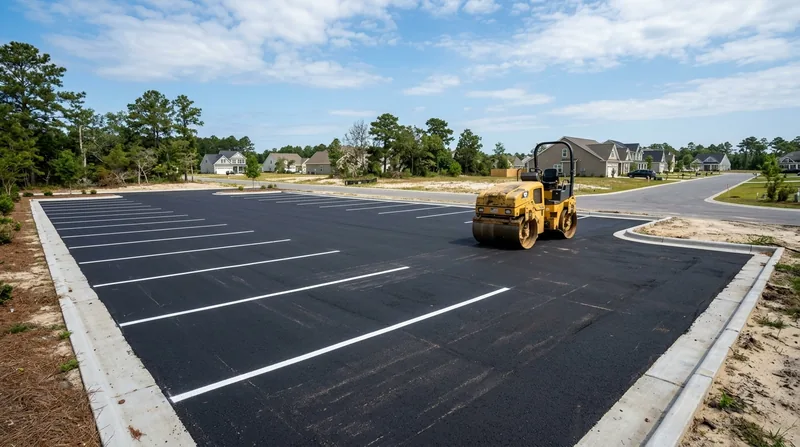




Parking Lot Paving & Construction in Wilmington means building a surface that sheds water fast on ground that sits low and flat. Across New Hanover County, commercial lots face the same challenge as residential driveways: standing water on sandy, poorly draining subgrade, especially in the newer subdivisions spreading into Pender and Brunswick counties where the water table sits close to the surface. A parking lot that holds water after rain becomes a liability, damages vehicles, erodes edges, and shortens pavement life. We grade and compact a full aggregate base, pitch the surface to move hurricane-season rainfall off quickly, and lay hot mix asphalt built to last in coastal terrain. The work is straightforward but demands local knowledge of how water moves through this peninsula, and how to build a base that won't settle or wash out when the next heavy rain comes.
Why Parking Lot Paving & Construction Matters in Wilmington's Flat Coastal Ground
Wilmington and the surrounding areas sit on terrain that drains poorly without deliberate work. Most commercial lots are flat or nearly flat, which means water pools unless the asphalt is pitched and the base underneath is properly compacted and sloped. A parking lot with standing water is not just an eyesore. Ponding accelerates pavement failure, creates liability for slip hazards and vehicle damage, and forces expensive repairs within a few years instead of a decade or more. The soil beneath most lots across New Hanover, Pender, and Brunswick counties is sandy fill with a high water table, especially near tidal creeks and marsh. Without a real base and proper grading, asphalt laid on wet or unstable ground will settle, crack, and break apart.
- Standing water on flat lots accelerates alligator cracking and base failure within 3 to 5 years.
- Proper grading and base compaction are the foundation of a parking lot that sheds water and lasts.
- Paving on poor subgrade or without slope wastes money and forces early replacement.
- Local stormwater rules in Wilmington, Leland, Carolina Beach, and other municipalities may require grading permits or stormwater management plans.
- A well-built lot protects your investment and keeps customers and tenants satisfied.
Getting the base right is the difference between a lot that holds up for 12 to 15 years and one that fails in half that time.
Key info: North Carolina does not require a state paving license for most parking lot work, but any single project at or above $40,000 requires a General Contractor license from the North Carolina Licensing Board for General Contractors. Check with your local building department in Wilmington or your municipality to confirm permit and contractor credential requirements for your scope.
How We Build a Parking Lot That Drains: Our Process in Wilmington
Parking lot construction in Wilmington starts with site grading and base preparation. We measure the lot, identify low spots where water pools, and design a grade that slopes water toward storm drains or natural drainage. Then we excavate soft or saturated soil, bring in clean aggregate base material, and compact it in lifts to create a solid, stable foundation. Once the base is set and proof-rolled, we pave hot mix asphalt pitched to move water off the surface. The entire process takes careful attention to subgrade condition, because the sandy fill common across our service area can settle if not properly confined and compacted.
- We visit the site and measure the lot, identifying existing drainage issues and low spots where water stands.
- We excavate and remove soft, saturated, or unsuitable subgrade material to a stable bearing layer.
- We bring in clean, crushed aggregate base and compact it in multiple lifts to the depth and density required for your lot size and expected vehicle load.
- We proof-roll the finished base to confirm compaction and stability before paving begins.
- We pave hot mix asphalt at the thickness required, pitched to shed water quickly, and finished smooth for safe driving and drainage.
This approach prevents the settling and edge erosion that plague lots built without proper base work, and it ensures that your lot drains fast even during the heavy rains of hurricane season.
Example: A 15,000 square foot commercial lot in Porters Neck with standing water in the northwest corner received 8 inches of compacted crushed stone base, pitched at 2 percent slope, then 2 inches of hot mix asphalt. The new lot sheds water to a catch basin and has remained dry and crack-free for over five years. The difference was the base and the slope.
Parking Lot Paving Methods and Approaches
| Approach | Description | Best for |
|---|---|---|
| Full-Depth Reconstruction | Remove old asphalt and subgrade, bring in new base and aggregate, compact, and pave new hot mix surface. | Lots with failed base, standing water, extensive cracking, or poor original construction. |
| Mill and Overlay | Remove the top 1 to 2 inches of old asphalt, mill it to recycled aggregate, and lay new hot mix on the remaining base. | Lots with surface wear but stable base, good drainage, and minor cracking. |
| Resurfacing with New Base Work | Repair or replace soft subgrade areas, add new base in low spots, then pave over the existing lot. | Lots with localized settling or water pooling but otherwise sound structure. |
| Grading and Drainage Improvement | Regrade the lot, add or improve storm drainage, and repave to improve water shedding without full removal. | Lots with standing water but adequate pavement thickness and base stability. |
Each approach depends on the condition of your existing lot, the subgrade, and your budget. A free on-site estimate helps us recommend the right method for your situation and your bottom line.
Parking Lot Paving & Construction Cost in Wilmington: What to Expect
Parking lot paving is quoted on-site because the cost depends entirely on the lot size, existing condition, subgrade, drainage needs, and the method chosen. A small lot with a stable base and minor surface wear may need only a mill and overlay. A larger lot with standing water and failed subgrade will require full-depth reconstruction with new base material, which costs significantly more per square foot. The cost of parking lot paving in Wilmington ranges from a few thousand dollars for a small resurfacing to $50,000 or more for a full-depth reconstruction on a large commercial lot. We provide a free commercial estimate with written tonnage and material specifications so you understand exactly what you are paying for and why.
Factors that move the price up or down include lot size, soil condition, whether the existing asphalt can be recycled or must be hauled away, drainage improvements needed, and site access for equipment. A lot in downtown Wilmington near the Cape Fear River with poor drainage and soft subgrade costs more to rebuild than a newer lot in Kings Grant with better-draining sandy soil and stable base. Getting multiple estimates from local contractors is always smart, because you can compare not just price but the scope of work and the materials each contractor proposes. Visit our pricing page for more detail on what drives the cost of parking lot work.
What to Look for When Hiring a Parking Lot Paving Contractor Near Wilmington
Parking lot paving is a significant investment, and choosing the right contractor matters. Look for a contractor who is fully insured and can provide proof of general liability and property damage coverage. Ask for references from other commercial or multi-unit projects in Wilmington, Leland, or Carolina Beach, and call them to ask about the quality of the work and whether the job was completed on time and on budget. Get a written estimate that includes the scope of work, material specifications, base depth and compaction, asphalt thickness, and total tonnage or square footage. Avoid any contractor who quotes a price without visiting the site, because parking lot work cannot be estimated from photos or a phone call.
Ask about permitting and whether your municipality requires a permit for grading or stormwater management. Check with your local building department in Wilmington or your city to understand what credentials or licenses may be required for your project scope. If your lot is part of a planned community or HOA, verify any architectural or material standards that apply. A reputable local contractor will help you navigate these requirements and can explain what permits are needed and who pulls them. Contact us for a free estimate and we will walk you through the entire process, answer your questions about permits and regulations, and give you a clear price and timeline before we start.
Parking Lot Paving & Construction in Wilmington: Pricing Guide
| Service | Price | Details |
|---|---|---|
| Free commercial estimate | Free | On-site measurement, soil and drainage assessment, written scope and material specifications |
| Mill and overlay | Starting at $2.50/sq ft | Depends on lot size, existing pavement condition, base stability, and whether recycled asphalt is hauled or reused |
| Full-depth reconstruction with new base | Starting at $4.50/sq ft | Includes excavation, subgrade removal, new aggregate base, compaction, proof-roll, and paving on larger or problem lots |
| Grading and drainage improvement | Starting at $1.50/sq ft | Regrade existing lot, improve slope, add or repair storm drainage, then repave without full removal |
| Travel and mobilization | Included | No separate charge for Wilmington and surrounding service areas, equipment and crew delivery included in estimate |
Indicative pricing, the exact cost depends on square footage, finish, and site access. Free personalized estimate within 24h at (910) 338-1662.


