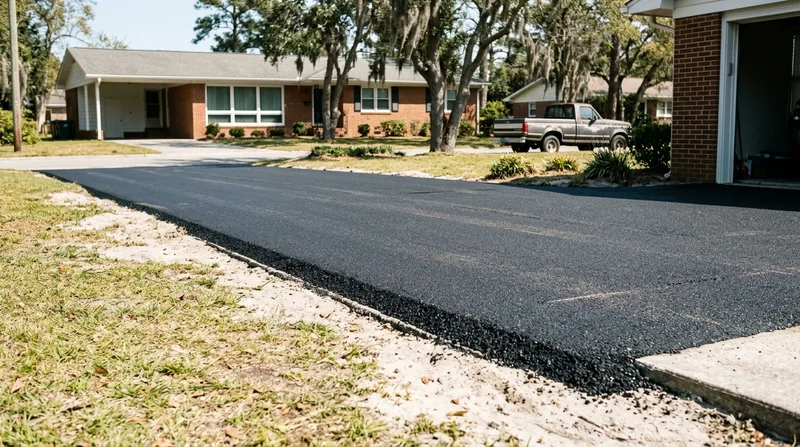




Asphalt Driveway Paving & Installation in Wilmington means building a durable surface on coastal sandy soil that drains well on higher ground but turns soft near tidal creeks and marsh. Wilmington's flat terrain and hurricane-season rainfall demand a driveway pitched to shed water fast, with a compacted aggregate base that holds up when the water table sits close to the surface. Whether you're replacing a failed apron in downtown's Victorian streets, extending a pad in the mid-century ranch belt, or installing a new drive in a subdivision backing up to Pender County creeks, the foundation and pitch matter more than the asphalt itself. We build that base, lay hot mix to the right thickness and slope, and handle the grading and drainage that keep water off your subgrade. A new asphalt driveway installed correctly will serve you for fifteen to twenty years in this climate, and honest guidance on whether you need paving, repair, or resurfacing is how we earn the work.
Why Asphalt Driveway Paving Matters in Wilmington's Coastal Environment
Wilmington sits on a peninsula where the Cape Fear River, tidal creeks, and marsh define the water table and soil behavior. Higher, sandy ground in the mid-century neighborhoods drains naturally, but newer subdivisions in Leland, Porters Neck, and southern Pender County often sit on poorly draining clay and silt with shallow water tables. A driveway poured without a proper base or pitched to hold water will settle, crack, and fail within five to seven years. Frost heave is not the problem here as it is inland; soft subgrade and standing water are. The other failure mode is edge erosion: sandy fill that was never confined or compacted washes away when rain runs off a flat lot, leaving the asphalt unsupported and breaking at the edges.
- A compacted aggregate base, typically four to six inches, prevents settlement and supports the asphalt layer above it.
- Proper pitch (usually one-quarter inch per foot) sheds water to the sides or to a drainage point, keeping moisture off the subgrade.
- Edge confinement and grading direct water away from the pavement perimeter, stopping erosion before it starts.
- Thickness matters: residential driveways here are typically two to three inches of hot mix over a prepared and proof-rolled base.
Getting these details right on the first install saves you from costly repairs and premature replacement down the road.
Local example: A homeowner in Wrightsville Beach extended a driveway over fill that had never been compacted. Within three years, the new section settled six inches while the old apron stayed level. The cost to fix it then was twice what proper base prep would have cost at the start. We see this pattern repeatedly in master-planned communities where the developer's site work was rushed.
For more on what happens when a driveway fails and how to fix it, see our guide to driveway repair in Wilmington.
North Carolina requires that any single construction undertaking of $40,000 or more must be performed by a contractor holding a General Contractor license from the North Carolina Licensing and General Contractor Board. Residential driveways are named in the NCLBGC Residential classification as ancillary site work. Most residential driveway installations fall below the threshold, but larger jobs, parking lot paving, and private road work may not. For guidance on permitting and contractor credentials in your municipality, contact your local building department or HOA architectural committee.
How We Install an Asphalt Driveway in Wilmington: The Process
Installation begins with understanding your site: soil type, drainage, existing pavement condition, and local permitting requirements. We measure the area, verify utility locations through North Carolina 811 (required by law before any excavation), and assess whether the existing base can be reused or must be removed and rebuilt. Flat coastal lots often need grading to establish slope; higher ground may need only base repair. We then excavate to subgrade, place and compact aggregate, proof-roll to verify bearing capacity, and lay hot mix asphalt to the specified thickness and pitch.
- We call 811 for utility locates and wait the required time before breaking ground on any excavation work.
- We grade and slope the site to direct water away from the pavement and structures, critical on Wilmington's flat terrain.
- We place compacted aggregate base in lifts, proof-rolling between lifts to confirm it will not settle under load.
- We lay hot mix asphalt at the correct temperature, thickness, and pitch while it is still workable.
- We allow the pavement to cure for 24 to 48 hours before you drive on it, and full strength develops over six to twelve months.
The entire process typically takes three to seven days from start to finish, depending on site size and weather.
Real example: A customer in Carolina Beach had a 1,200-square-foot driveway with a shallow water table visible in the excavation. We installed six inches of compacted stone base instead of the typical four, pitched the pad one-quarter inch per foot, and added a gravel swale at the low end to direct runoff away from the house. Two years in, zero settlement, zero edge erosion. The extra base cost $300 more than a standard job; avoiding a $4,000 replacement five years later made it the right call.
If you have an existing driveway that is cracking or settling, see whether asphalt resurfacing or overlay can extend its life before you commit to full replacement.
Installation Methods and Approaches
| Approach | Description | Best For |
|---|---|---|
| Full-Depth Replacement | Remove old asphalt and base, excavate to subgrade, place new compacted base, and lay new hot mix asphalt. | Driveways with failed base, extensive alligator cracking, or poor drainage that cannot be fixed by overlay. |
| Asphalt Overlay | Mill the top layer if needed for grade, then lay new hot mix asphalt over the existing base. | Structurally sound driveways with surface cracks, weathering, or minor rutting; base must be stable. |
| Mill and Overlay | Remove the top one to two inches of old asphalt, recycle it, and lay new hot mix to restore grade and profile. | Driveways that have settled or rutted but have a solid base; reduces material cost and maintains thickness. |
| Recycled Asphalt Millings | Compacted recycled asphalt material (RAP) from milling operations, suitable for low-traffic rural driveways and gravel lanes. | Budget-conscious homeowners in Castle Hayne, Burgaw, and other rural areas; not suitable for high-traffic or sloped sites. |
| Driveway Extension or Apron | Grade, base, and pave an addition to an existing driveway, matching slope, thickness, and compaction standards. | Homeowners needing wider access, a turnaround, or an apron to meet the street; verify HOA and municipal curb-cut rules first. |
Asphalt Driveway Paving & Installation Cost in Wilmington: What to Expect
Asphalt driveway paving in Wilmington starts at approximately $6 per square foot for a straightforward full-depth replacement on stable ground with good access. A 600-square-foot driveway at that rate runs roughly $3,600 before site-specific factors. What moves the cost up or down: soil condition and water table depth (poor drainage or soft subgrade requires thicker base), existing pavement removal (full-depth replacement costs more than overlay), site access (narrow lots or tree-lined drives slow the work), and local permitting (some municipalities require an apron permit or stormwater plan). An overlay on a sound base runs $3 to $4 per square foot because you skip excavation and base work. A full replacement on poor ground with deep excavation can reach $8 to $10 per square foot.
The honest approach is to get a site visit and a written estimate with tonnage and thickness specified. Two or three estimates from local contractors let you compare not just price but method: if one contractor proposes a two-inch base and another proposes four inches, ask why. We provide written estimates that spell out aggregate tonnage, asphalt tonnage, thickness, and pitch so you can compare apples to apples. See our full pricing overview for typical ranges across our service menu, and call us at (910) 338-1662 for a free estimate on your specific property.
What to Look for When Hiring an Asphalt Paving Contractor Near Wilmington
The paving trade has a reputation for itinerant door-to-door crews offering "leftover asphalt" at a too-good price, no written contract, and a large cash deposit due before work starts. Protect yourself by verifying any contractor's credentials and approach. We are fully insured and maintain a local address and local plates because being verifiably local, with a phone number and a physical presence in Wilmington, is the strongest trust signal in this business. Ask any contractor for a written estimate with tonnage and thickness, multiple references from work done in the last two years, and proof of insurance. Verify that they understand local permitting: driveway aprons, curb cuts, and stormwater rules vary from Wilmington to Carolina Beach to Leland. If your property is in an HOA, check architectural guidelines; many master-planned communities restrict driveway material or extension. Call 811 before any excavation; it is the law in North Carolina and a sign of a professional operation. Do not sign a contract with a lifetime warranty on asphalt: asphalt is a material, not a manufactured product, and no contractor can guarantee it forever. A one- to three-year workmanship warranty on the installation is honest and standard.
- Ask for a written estimate that includes aggregate tonnage, asphalt tonnage, thickness in inches, and pitch specifications.
- Request three references from completed driveways or parking lots in Wilmington or nearby towns, completed within the last two years.
- Verify insurance coverage and ask for a certificate of insurance naming you as additional insured during the work.
- Confirm that the contractor will call 811 for utility locates before any excavation, and ask to see the locate marks on your property.
- Check your local building department website or call the permitting office to learn whether your driveway apron, extension, or curb cut requires a permit.
- If you live in an HOA community, review architectural guidelines for driveway material and size before signing a contract.
- Do not pay a large cash deposit before work begins; ask for a payment schedule tied to project milestones.
A contractor who takes the time to understand your site, explains the method clearly, and puts it all in writing is the one worth hiring. Contact us for a free estimate and a chance to ask questions before you commit.
Asphalt Driveway Paving & Installation in Wilmington: Pricing Guide
| Service | Price | Details |
|---|---|---|
| Driveway Overlay (sound base) | From $3/sq ft | New hot mix over existing stable base, no excavation needed, fastest and most affordable option |
| Full-Depth Replacement (standard ground) | From $6/sq ft | Remove old asphalt and base, excavate, place compacted aggregate, lay new asphalt, includes grading |
| Full-Depth Replacement (poor drainage or soft subgrade) | From $8/sq ft | Deeper excavation, thicker base, enhanced grading and drainage, typical for near-creek and low-lying lots |
| Driveway Extension or Apron | From $6/sq ft | Grade, base, and pave new area adjacent to existing drive, cost varies by soil and access difficulty |
| Mill and Overlay | From $4/sq ft | Remove and recycle top layer, lay new asphalt, restores grade without full excavation, material-efficient |
| Free Estimate | No charge | Site visit, written estimate with tonnage and thickness, response within 24 hours, no obligation |
Indicative pricing, the exact cost depends on square footage, finish, and site access. Free personalized estimate within 24h at (910) 338-1662.


