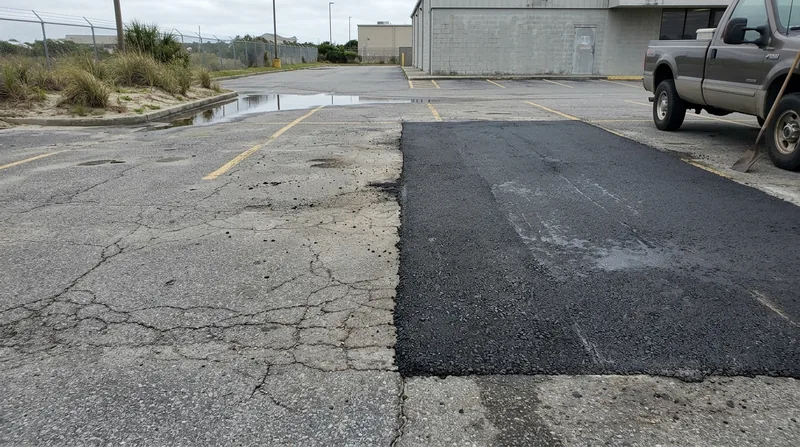




Parking lot repair and resurfacing in Wilmington demands a clear-eyed approach to the ground beneath the asphalt. Wilmington's parking lots crack and pothole where sandy fill was never properly confined, where the water table sits close enough to the surface that standing water softens the subgrade, and where the flat coastal terrain offers no natural drainage. A pothole that opens in spring often signals a failed base, not just a surface problem. We cut out the failed section, rebuild the base to proper compaction and thickness, and patch flush with hot mix so the lot holds through the next hurricane season and the heavy rains that follow. The difference between a patch that holds and money thrown away is preparation: base work, drainage, and the tonnage spec written on the estimate before we pour.
Why Parking Lot Repair Matters in Wilmington's Coastal Climate
Wilmington sits on the Cape Fear Peninsula, where sandy soil and a high water table are the norm across New Hanover, Pender, and Brunswick counties. Parking lots poured without a real base, or with base material that was never compacted, settle and fail long before the asphalt itself wears out. The failure is not frost heave, as it is in northern states, but saturation and edge erosion where the sandy fill was never confined by proper grading and drainage. A single heavy rain after a hurricane can saturate the subgrade under a low-lying lot, weakening it for months. Pothole repair that ignores the base is a temporary fix that costs you again in six months.
- Soft subgrade from standing water or poor drainage causes potholes to return quickly if only the surface is patched.
- Sandy fill without confinement erodes from the edges inward, opening the lot to water infiltration and base failure.
- Flat terrain means water does not drain naturally; parking lots need slope, swales, or proper grading to shed water fast.
- Hurricane-season rains saturate the ground table, weakening a marginal base that holds fine in dry months.
Parking lots that fail in Wilmington fail from the bottom up, which is why we always inspect the base before we quote a repair.
Key info: A parking lot in Leland or Porters Neck that has potholes in the same spot month after month, or that develops alligator cracking across large sections, usually has a base problem. Patching the surface alone will not solve it. We recommend a site visit to determine whether the lot needs spot repair, section reconstruction, or full resurfacing.
For detailed guidance on what parking lot paving and construction looks like from the ground up, see our parking lot paving and construction page.
How We Repair and Resurface Parking Lots in Wilmington
Parking lot repair starts with understanding what failed. We measure the lot, identify all failed sections, probe the base to determine depth and condition, and write a spec that covers both surface and base work. For small potholes or isolated cracks, we cut out the bad asphalt, inspect and repair the base if needed, and patch with hot mix. For widespread failure, we may recommend full-depth patching of multiple sections or a complete resurfacing. The key is matching the scope to the problem and the budget to the work that will actually hold.
- We measure the lot and document all failed areas, potholes, alligator cracking, and edge erosion.
- We probe the base to check depth, compaction, and drainage; a weak or saturated base changes the repair strategy.
- For isolated potholes, we cut out the failed section, repair or rebuild the base, and patch flush with hot mix asphalt.
- For widespread failure, we may recommend full-depth patching of large sections or a resurfacing overlay if the base is sound.
- We grade and improve drainage where water is pooling, so the lot sheds water and the base stays dry.
- We write a tonnage spec on every estimate so you know exactly what you are paying for.
The work is complete when the lot is smooth, drains properly, and the new asphalt is flush with the surrounding pavement.
Real example: A small office park in Wilmington had three potholes in a row near the storm drain. We cut them out, found the base was saturated and settling, rebuilt the base with proper grading to slope away from the drain, and patched with hot mix. We also extended a swale to improve drainage across the low corner of the lot. The potholes have not returned in two years because we fixed the cause, not just the symptom.
For more on how pothole repair and asphalt patching work in practice, see our dedicated service page.
Parking Lot Repair Methods and Approaches
| Approach | Description | Best for |
|---|---|---|
| Pothole Patching | Cut out the failed section, inspect and repair the base if soft or saturated, fill with hot mix asphalt compacted to grade. | One to three isolated potholes, sound base material, no widespread cracking. |
| Full-Depth Patching | Remove failed asphalt and base material in the problem area, rebuild base to proper depth and compaction, overlay with new hot mix. | Multiple potholes in one section, failed base, or standing water that returns after rain. |
| Resurfacing Overlay | Mill the top layer of worn asphalt, grade and improve drainage, lay new hot mix asphalt over the existing base. | Surface wear and minor cracking across the lot, base is sound and well-draining, budget does not allow full replacement. |
| Drainage and Grading Repair | Regrade low spots, improve slope toward storm drains, add swales or berms to shed water, then patch or resurface the asphalt. | Lots with standing water, flat terrain, or repeat pothole problems tied to saturation. |
| Edge and Perimeter Repair | Stabilize eroding edges where sandy fill was never confined, add proper base material and curbing if needed, patch asphalt flush. | Edge crumbling, washout along the lot perimeter, or water running off into adjacent property. |
Parking Lot Repair and Resurfacing Cost in Wilmington: What to Expect
Parking lot repair in Wilmington starts at around $650 to $1,200 for a single pothole or small failed section, including base inspection and repair. A full-depth patch of a larger area (200 to 400 square feet) typically runs $1,500 to $3,500, depending on base condition and the amount of grading needed. Resurfacing an entire small lot (5,000 to 10,000 square feet) with overlay and improved drainage runs $3,000 to $8,000 or more. The cost depends on lot size, base condition, whether drainage work is needed, and whether we are patching isolated spots or resurfacing the whole surface.
Several factors move the price up or down. A lot with a soft or saturated subgrade costs more because we must rebuild the base properly. A flat lot with poor drainage costs more because we must regrade and add swales or improve the slope. A lot with multiple isolated potholes may be cheaper per square foot than a lot with widespread alligator cracking, because cracking signals base failure and usually requires resurfacing or full-depth work. Large lots with good access and level terrain are more efficient and cost less per square foot than small, tight lots in downtown Wilmington or Wrightsville Beach where we have limited staging room.
We always recommend getting two to three estimates from local contractors. Every estimate should include the scope of work, the thickness of asphalt or base material being laid, the tonnage, and the square footage. If two estimates are very different, ask why. A price that is too good usually means incomplete base work or no tonnage spec. For detailed pricing information and a free, no-obligation estimate, see our pricing page or call us at (910) 338-1662.
Parking Lot Repair and Resurfacing Near Me: What Wilmington Property Owners Should Know When Hiring
Hiring the right contractor for parking lot repair is about more than price. You want someone local, someone who knows Wilmington's sandy soil and drainage challenges, and someone who puts the work in writing. Before you call, know what you are looking for: are you fixing a few potholes, resurfacing the whole lot, or improving drainage? Once you have narrowed the scope, get multiple estimates and compare them carefully.
When you talk to a contractor, ask for a written estimate that includes the square footage, the depth and type of base work, the tonnage of asphalt, and the timeline. Ask about insurance coverage and verify it directly with the insurance company if the amount is large. Ask for references from other parking lot work in Wilmington or nearby, and call them. If your lot is in an HOA or a master-planned community, check the architectural standards to confirm that asphalt repair is permitted and that no special finish or color is required. If your lot is in a city or county jurisdiction, ask whether a permit is needed for the work. We can help you navigate local permitting, but the building department rules vary from Wilmington to Leland to Carolina Beach, so verify with your local city hall before we start.
- Get a written estimate that names the scope, square footage, base depth, and tonnage of asphalt being laid.
- Ask the contractor to verify insurance coverage with the insurance company directly before you sign.
- Request references from other parking lot repairs or resurfacing work done in Wilmington or the surrounding area.
- Check your HOA rules or local building department to confirm whether a permit is required and what standards apply.
- Verify that the contractor is local and has a local address and phone number; out-of-state crews and unsolicited door-to-door offers are a red flag.
- Ask whether the estimate includes a tonnage spec and what happens if the actual tonnage differs from the estimate.
For a free estimate and to discuss your parking lot repair needs in detail, contact us online or call (910) 338-1662. We are local, we work in Wilmington and the surrounding areas, and we put every job in writing.
Parking Lot Repair & Resurfacing in Wilmington: Pricing Guide
| Service | Price | Details |
|---|---|---|
| Single Pothole Repair | Starting at $650 | Includes cutting out failed asphalt, base inspection and repair, and hot mix patch flush to grade. |
| Full-Depth Patch (200-400 sq ft) | Starting at $1,500 | Removal of failed asphalt and base, base rebuild to proper compaction, new hot mix overlay, drainage grading if needed. |
| Parking Lot Resurfacing Overlay (5,000-10,000 sq ft) | Starting at $3,000 | Milling worn surface, grading and drainage improvement, new hot mix asphalt overlay, assumes sound base and good access. |
| Large Lot or Complex Repair | On estimate | Requires site visit to assess base condition, drainage, lot size, and scope of work; pricing varies significantly by site. |
| Free Estimate | No charge | Response within 24 hours at (910) 338-1662, includes site inspection, written scope, and no obligation to book. |
Indicative pricing, the exact cost depends on square footage, finish, and site access. Free personalized estimate within 24h at (910) 338-1662.


